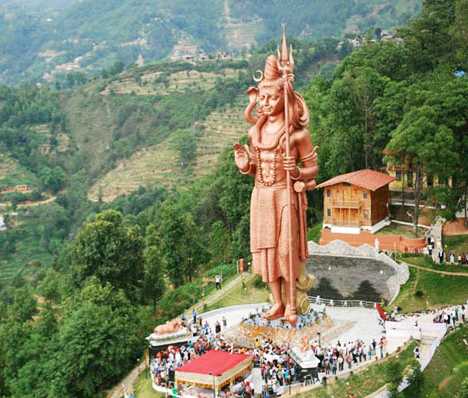
Kailashnath Mahadev (WORLD'S TALLEST LORD SHIVA STATUE)

WORLD'S TALLEST LORD SHIVA STATUE IS LOCATED IN NEPAL (KAILASHNATH MAHADEV. 143 FEET HIGH THIS STATUE IS ONE OF ITS KIND.

Kailashnath Mahadev Night Scene (WORLD'S TALLEST LORD SHIVA STATUE)

143 FEET HIGH STATUE WAS Inaugurated ON 21st June'2010

KAILASHNATH MAHADEV

This statue was inaugurated by one of the only four shankracharya from badri and the tourist minister on the 21st June 2010.

KAILASHNATH MAHADEV

This Statue is Made By Mr.Kamal Jain and It took him almost 5 years just to find this perfect location where he wanted his dream to come true.The construction started in 2004 and was completed in 2010.

KAILASHNATH MAHADEV

The Tallest lord shiva statue in the world (143 feet high) Situated in Nepal.

Tuesday, April 19, 2011

Maha Mrityunjaya Mantra


The Maha Mrityunjay Mantra or Lord Shiva Mantra is considered extremely powerful and significant by the Hindus. Also known as the Moksha Mantra of Lord Shiva, chanting of Maha Mrityunjaya Mantra is said to create divine vibrations that heals. Devotees of Lord Shiva further believe that Maha Mrityunjay evokes the Shiva within human beings and removes the fear of death, liberating one from the cycle of death and rebirth.

Significance of Maha Mrityunjaya Mantra
Devotees strongly believe that proper recitation of the Maha Mrityunjaya rejuvenates, bestows health, wealth, long life, peace, prosperity and contentment. It is said that chanting of Shiva Mantra generates divine vibrations that ward off all the negative and evil forces and creates a powerful protective shield. Besides, it is said to protect the one who chants against accidents and misfortunes of every kind. Recitation of the mantra creates vibration that pulsates through every cell, every molecule of human body and tears away the veil of ignorance. Hindus believe that recitation of the mantra ignites a fire within that consumes all negativity and purifies entire system. It is also said to have a strong healing power and can cure diseases declared incurable even by the doctors. Many believe Maha Mrityunjay Mantra to be a mantra that can conquer death and connect human beings to their own inner divinity.

The Maha Mrityunjaya Mantra
Mrityunjay Mantra has been taken from the Sukla Yajurveda Samhita III. 60. The Mantra is addressed to Lord Shiva and is a centuries old technique of connecting one to pure consciousness and bliss.

Om Tryamlakam Yajamahe
Sugandhim Pusti - vardhanam |
Urva - rukamiva Bandhanan
Mrtyor - muksheeya Ma - amritat ||

Meaning:
Om. We worship The Three-Eyed Lord Shiva who is fragrant and who increasingly nourishes the devotees. Worshipping him may we be liberated from death for the sake of immortality just as the ripe cucumber easily separates itself from the binding stalk.

Explanation:
The mantra is a prayer to Lord Shiva who is addressed as Sankara and Trayambaka. Sankara is sana (blessings) and Kara (the Giver). Trayambaka is the three eyed one (where the third eye signifies the giver of knowledge, which destroys ignorance and releases us from the cycle of death and rebirth).

Best Time to Chant:
Chanting the Maha Mrityunjaya Mantra with sincerity, faith and devotion in Bramha Muhurata is very beneficial. But one can also do Maha Mrityunjaya japa anytime in a pure environment with great benefit and discover the happiness that's already within.

Sunday, April 17, 2011

LORD SHIVA'S BHAJAN'S

A good reliable link on which you can download your LORD SHIVA'S BHAJAN'S
                        http://mp3bear.com/?q=mahadev+bhajans

Mahashivaratri

Mahashivaratri Festival

Mahashivaratri Festival or the ‘The Night of Shiva’ is celebrated with devotion and religious fervor in honor of Lord Shiva, one of the deities of Hindu Trinity. Shivaratri falls on the moonless 14th night of the new moon in the Hindu month of Phalgun, which corresponds to the month of February - March in English Calendar. Celebrating the festival of Shivaratri devotees observe day and night fast and perform ritual worship of Shiva Lingam to appease Lord Shiva.

Legends of MahashivratriThere are various interesting legends related to the festival of Maha Shivaratri. According to one of the most popular legends, Shivaratri marks the wedding day of Lord Shiva and Parvati. Some believe that it was on the auspicious night of Shivaratri that Lord Shiva performed the ‘Tandava’, the dance of the primal creation, preservation and destruction. Another popular Shivratri legend stated in Linga Purana states that it was on Shivaratri that Lord Shiva manifested himself in the form of a Linga. Hence the day is considered to be extremely auspicious by Shiva devotees and they celebrate it as Mahashivaratri - the grand night of Shiva.

Traditions and Customs of ShivaratriVarious traditions and customs related to Shivaratri Festival are dutifully followed by the worshippers of Lord Shiva. Devotees observe strict fast in honor of Shiva, though many go on a diet of fruits and milk some do not consume even a drop of water. Devotees strongly believe that sincere worship of Lord Shiva on the auspicious day of Shivaratri, absolves a person of sins and liberates him from the cycle of birth and death. Shivaratri is considered especially auspicious for women. While married women pray for the well being of their husbands unmarried women pray for a husband like Lord Shiva, who is regarded as the ideal husband.

To mark the Shivratri festival, devotees wake up early and take a ritual bath, preferably in river Ganga. After wearing fresh new clothes devotees visit the nearest Shiva temple to give ritual bath to the Shiva Lingum with milk, honey, water etc.

On Shivaratri, worship of Lord Shiva continues all through the day and night. Every three hours priests perform ritual pooja of Shivalingam by bathing it with milk, yoghurt, honey, ghee, sugar and water amidst the chanting of “Om Namah Shivaya’ and ringing of temple bells. Nightlong vigil or jaagran is also observed in Shiva temples where large number of devotees spend the night singing hymns and devotional songs in praise of Lord Shiva. It is only on the following morning that devotee break their fast by partaking prasad offered to the deity.

How To Worship Lord Shiva


                      How To Worship Lord Siva


In the Sivapurana it has been told that once Sanatkumara was traveling in an aircraft and happened to see sage Parasara, practicing austerities (tapas ) on the banks of the river Saraswathi. Sanatkumara stopped by and asked the latter the reason for being at such a lonely place. Sage Parasara replied that having done his ordained duties as a teacher and helped lots of students to gain knowledge, he decided to practice austerities for his own salvation. Sanatkumara then revealed to him the knowledge he received earlier from Nandikeswara and suggested him to practice mananam, sravanam and kirtanam instead of austerities as effective means of attaining the grace of Lord Siva and achieve liberation. These three means are explained below.
  1. Mananam: Uttering the Siva mantras or prayers, contemplating or meditating upon the grandeur and significance of Siva or the sacred texts of Saivism and performing similar mental activities.
  2. Sravanam: Listening from others, or in a gathering of Siva's devotees, about Lord Siva, the concepts of Saivism, the books on Saivism, the life and activities of Nayanars or other devotees of Siva.
  3. Kirtanam. Singing the glory of Lord Siva either alone or in the company of other devotees. When it is done in groups it is called bhajan. Devotional singing helps the mind become stabilized in God.

The Worship of Sivalinga

According to the Sivapurana, in the age of Kali (kaliyuga) ,worship of Siva in the form of Sivalinga is the best means of liberation. Woship of Sivalinga can be done either at home or in a Siva temple or a sacred place such as the banks of a sacred river. The linga has to be worshipped by the traditional means (sadupachara) of
  1. dhyana,
  2. avahana,
  3. asana,
  4. padya,
  5. arghya,
  6. achamaniya,
  7. abhisheka,
  8. vastra,
  9. bhasma,
  10. gandha,
  11. akshata,
  12. pushpa,
  13. bilva,
  14. dhupa,
  15. dipa,
  16. naivedya,
  17. tambula,
  18. mahanirajana,
  19. mantrapushpa,
  20. namaskara and
  21. prardhana.

Friday, April 15, 2011

Nataraja


Nataraja or Nataraj, the dancing form of Lord Shiva, is a symbolic synthesis of the most important aspects of Hinduism, and the summary of the central tenets of this Vedic religion. The term 'Nataraj' means 'King of Dancers' (Sanskrit nata = dance; raja = king). In the words of Ananda K. Coomaraswamy, Nataraj is the "clearest image of the activity of God which any art or religion can boast of…A more fluid and energetic representation of a moving figure than the dancing figure of Shiva can scarcely be found anywhere," (The Dance of Shiva)The Origin of the Nataraj Form:
An extraordinary iconographic representation of the rich and diverse cultural heritage of India, it was developed in southern India by 9th and 10th century artists during the Chola period (880-1279 CE) in a series of beautiful bronze sculptures. By the 12th century AD, it achieved canonical stature and soon the Chola Nataraja became the supreme statement of Hindu art.
The Vital Form & Symbolism:
In a marvelously unified and dynamic composition expressing the rhythm and harmony of life, Nataraj is shown with four hands represent the cardinal directions. He is dancing, with his left foot elegantly raised and the right foot on a prostrate figure — 'Apasmara Purusha', the personification of illusion and ignorance over whom Shiva triumphs. The upper left hand holds a flame, the lower left hand points down to the dwarf, who is shown holding a cobra. The upper right hand holds an hourglass drum or 'dumroo' that stands for the male-female vital principle, the lower shows the gesture of assertion: "Be without fear."
Snakes that stand for egotism, are seen uncoiling from his arms, legs, and hair, which is braided and bejeweled. His matted locks are whirling as he dances within an arch of flames representing the endless cycle of birth and death. On his head is a skull, which symbolizes his conquest over death. Goddess Ganga, the epitome of the holy river Ganges, also sits on his hairdo. His third eye is symbolic of his omniscience, insight, and enlightenment. The whole idol rests on a lotus pedestal, the symbol of the creative forces of the universe.
The Significance of Shiva's Dance:
This cosmic dance of Shiva is called 'Anandatandava,' meaning the Dance of Bliss, and symbolizes the cosmic cycles of creation and destruction, as well as the daily rhythm of birth and death. The dance is a pictorial allegory of the five principle manifestations of eternal energy — creation, destruction, preservation, salvation, and illusion. According to Coomerswamy, the dance of Shiva also represents his five activities: 'Shrishti' (creation, evolution); 'Sthiti' (preservation, support); 'Samhara' (destruction, evolution); 'Tirobhava' (illusion); and 'Anugraha' (release, emancipation, grace).
The overall temper of the image is paradoxical, uniting the inner tranquility, and outside activity of Shiva.
A Scientific Metaphor:
Fritzof Capra in his article "The Dance of Shiva: The Hindu View of Matter in the Light of Modern Physics," and later in the The Tao of Physics beautifully relates Nataraj's dance with modern physics. He says that "every subatomic particle not only performs an energy dance, but also is an energy dance; a pulsating process of creation and destruction…without end…For the modern physicists, then Shiva's dance is the dance of subatomic matter. As in Hindu mythology, it is a continual dance of creation and destruction involving the whole cosmos; the basis of all existence and of all natural phenomena."
The Nataraj Statue at CERN, Geneva:
In 2004, a 2m statue of the dancing Shiva was unveiled at CERN, the European Center for Research in Particle Physics in Geneva. A special plaque next to the Shiva statue explains the significance of the metaphor of Shiva's cosmic dance with quotations from Capra: "Hundreds of years ago, Indian artists created visual images of dancing Shivas in a beautiful series of bronzes. In our time, physicists have used the most advanced technology to portray the patterns of the cosmic dance. The metaphor of the cosmic dance thus unifies ancient mythology, religious art and modern physics."
To sum up, here's an excerpt from a beautiful poem by Ruth Peel:
"The source of all movement,
Shiva's dance,
Gives rhythm to the universe.
He dances in evil places,
In sacred,
He creates and preserves,
Destroys and releases.

We are part of this dance
This eternal rhythm,
And woe to us if, blinded
By illusions,
We detach ourselves
From the dancing cosmos,
This universal harmony…"

Shiva Legends Or Stories


Story of Shiva Lingam - Why Shiva is worshipped in the Phallic Form


This is an interesting story regarding the worship of Lord Shiva in the phallic form. It is believed that once Brahma and Vishnu, the two deities of the Trinity, got into an argument regarding their supremacy. Lord Brahma declared himself to be more admired, being the creator. While the preserver, Vishnu, pronounced that he commanded more admiration. Just then a huge pillar of fire (lingam), called as Jyotirlinga, appeared in flames, before them. This Lingam enthralled both Brahma and Vishnu, with its hastily increasing size. With this incident, they forgot their quarrel and decided to find its size. Vishnu took the form of boar and went to the netherworld. Brahma assumed the form of a Swan and flew to the skies. However both of them were unsuccessful in completing the self-assumed tasks. At that time, Shiva appeared out of the lingam and acknowledged that he was the progenitor of both, Brahma and Vishnu. So, he should be worshipped in his phallic (lingam) form, and not in the anthropomorphic form.


Story of Shiva and the Hunter


Here is one more interesting story of Lord Shiva, showing his merciful nature. Once a hunter was wandering in a dense forest, to chase a deer and suddenly he found himself on the banks of river Kolidum, where he heard the roar of a tiger. In order to defend himself from the tiger, he climbed up a tree close by. The Tiger sat on the ground below the tree without the purpose to leave. The huntsman stayed at the tree whole night and to keep himself awake, he plucked one leaf after another from the tree and threw it down. There was a Shiva Lingam under the tree and gracefully the tree turned out to be a ''bilva'' tree (leaves of this tree are adored by Shiva). Without any knowledge, the huntsman had delighted the deity by pouring Bilva leaves all night. With the arrival of the sun, the hunter looked down and found the tiger gone. In its place, Lord Shiva was standing and he prostate before the lord. With Shiva's blessings, he attained salvation from the bondage of the material world.


Ganga Comes Down to Earth


A legend from the Ramayana speaks of King Bhagirath who once meditated before Lord Brahma for a thousand years for the salvation of the souls of his ancestors. Pleased with his devotion Brahma granted him a wish. He requested the Lord to send the river Ganges down to earth from heaven so that she could flow over his ancestors' ashes and wash their curse away and allow them to go to heaven. Brahma granted his wish but asked him to pray to Shiva, for he alone could support the weight of her descent. Accordingly he prayed to Shiva and he allowed the Ganges to descend on his head, and after meandering through his thick matted locks, the holy river reached the earth. This story is re-enacted by bathing the 'linga'.


The Tiger & the Leaves


Once a hunter while chasing a deer wandered into a dense forest and found himself on the banks of river Kolidum when he heard the growl of a tiger. To protect himself from the beast he climbed up a tree nearby. The tiger pitched itself on the ground below the tree fostering no intention to leave. The hunter stayed up in the tree all night and to keep himself from falling asleep, he gently plucked one leaf after another from the tree and threw it down. Under the tree was a Shiva Linga and the tree blessedly turned out to be a bilva tree. Unknowingly the man had pleased the deity with bilva leaves. At sunrise, the hunter looked down to find the tiger gone, and in its place stood Lord Shiva. He prostrated before the Lord and attained salvation from the cycle of birth and death.


Why Shiva is Worshipped in His Phallic Form


According to another legend, once Brahma and Vishnu, two other deities of the holy Trinity, had an argument as to their supremacy. Brahma being the Creator declared himself to be more revered, while Vishnu, the Preserver, pronounced that he commanded more respect.Just then a colossal 'lingam', known as Jyotirlinga, blanketed in flames, appeared before them. Both Brahma and Vishnu were awestruck by its rapidly increasing size. They forgot their quarrel and decided to determine its size. Vishnu assuming the form of a boar went to the netherworld and Brahma as a swan flew to the skies. But both of them failed to accomplish the self-assumed tasks. Then, Shiva appeared out of the 'lingam' and stated that he was the progenitor of them both and that henceforth he should be worshiped in his phallic form, the 'lingam', and not in his anthropomorphic form.


Bad Credit Loans
Bad Credit Loans unsecured personal bad credit loans. Bad credit guaranteed approval bad credit loan, loan for bad credit, loan with bad credit.

       Who Is Lord Shiva      


Lord Shiva Pictures


Shiva is a major Hindu god and one aspect of Trimurti. In the Shaiva tradition of Hinduism, Shiva is seen as the Supreme God. In the Smarta tradition, he is one of the five primary forms of God. Followers of Hinduism who focus their worship upon Shiva are called Shaivites or Shaivas. Shaivism, along with Vaisnava traditions that focus on Vishnu and Sakta traditions that focus on the goddess Devi are three of the most influential denominations in Hinduism. Shiva is usually worshipped in the form of Shiva linga. In images, he is generally represented as immersed in deep meditation or dancing the Tandava upon Maya, the demon of ignorance in his manifestation of Nataraja, the lord of the dance. In some Hindu denominations, Brahma, Vishnu, and Shiva represent the three primary aspects of the divine in Hinduism and are collectively known as the Trimurti. In this school of religious thought, Brahma is the creator, Vishnu is the maintainer or preserver, and Shiva is the destroyer or transformer.


Shiva the lord of the lords

Shiva is lord of the lords and it is really not easy to write/explain everything about shiva.However many have tried to explain him and praised him as per their knowledge but the explanation is endless and it is un-imaginable from a human being even devas, asuras and other rishi munis have very little words to explain about the lord almighty.
Shiva means the supreme one, the auspicious one, the pure one and for me the beloved one. Shiva is named as Pashupati which means the Lord of all living beings either it is humans, devas, asuras or any creatures. Another name Mahadeva depicts the great God, supreme in all devas(Gods).
The God staying in a state blissful, enjoying in Its Own Self eternally, without any flaws is the Supreme Lord shiva. The Perfection is the completeness - there is nothing external that is required to make the Self blissful.
Lord Shiva is reckoned among the Tridevas (trimity). Brahma is the creator, Lord Vishnu is the preserver and Lord Shiva is the destroyer. Shiva is the lord of Shakti also.
Lord shiva is absolute which does not have any parents  which never takes birth Which is all alone without association with any of the creatures or creations enjoying in the Self. God is the only one who is dependable for anybody / anything to surrender to as It is the only perennial Being.  Hence God is the Lord of all creatures (lives/souls). For this reason the Lord is hailed as pashupati (Lord of living beings). Whether it is devas or asuras or humans or other creatures all are pashus. That being the case how could the Lord be partial to one section of pashus and withdrawing the Grace for the other ? So anybody who worships the Lord sincerely could get blessed with Its Grace irrespective of the caste, creed, race, power, status and qualities.
It is in fact to be noted that Lord shiva is worshipped by the devas like viShNu, braHma, indra, by asuras like bANa, rAvaNa, tripura, sUrapadma, by humans like sha~Nkara bhagavatpAda, samban^dhar, appar, by other creatures like jaTAyu, sampAdi (eagles), vAli (monkey) and the list goes on and on. One finds in the purANas the variety of people of different backgrounds and qualities worship the Lord shiva. There are many histories of temples which talk of the cranes, bees, elephants, spiders, snakes worshipping the Lord -and getting blessed. So the Lord as the Supreme blesses anyone who worships in sincere devotion. There is no discrimination on who the seeker is. The Lord is so merciful that He showers the boons one look for when there is a determination to seek Him. It is evident from the history of asura bANa who attained a great fame of his valor and got the place in the abode of Lord shiva all due to his determined worship of the Lord.
Lord shiva is the God of all. Like the mother He showers the grace for all the children, but the misusing children get punished. This Supreme Lord better than a mother does not withhold the grace, He is our beloved pashupati.
The God would not be biased. It would not differentiate between one group versus the other, whether it be divines or daemons or humans or plats or creatures or on sex or on race etc. All that matters is dharma and the pure devotion towards It. No doubt this lovely Lord shiva is worshipped alike by divines, daemons, scholars, not much learnt simple, and the other creatures.

108 names of Lord Shiva


Different Names of Lord Shiva

One of the most important Hindu deities, Lord Shiva is known by several names. The Shiva Purana list 1008 names for Lord Shiva. Each of these names in Sanskrit signifies certain attribute of the Lord. Given here are 108 names of Lord Shiva with their meaning.
108 Names of Lord Shiva
S NoLord Shiva NameMeaning
1AashutoshOne who fulfills wishes instantly
2AjaUnborn
3AkshayagunaGod with limitless attributes
4AnaghaWithout any fault
5AnantadrishtiOf infinite vision
6AugadhOne who revels all the time
7AvyayaprabhuImperishable Lord
8BhairavLord of terror
9BhalanetraOne who has an eye in the forehead
10BholenathKind hearted Lord
11BhooteshwaraLord of ghosts and evil beings
12BhudevaLord of the earth
13BhutapalaProtector of the ghosts
14ChandrapalMaster of the moon
15ChandraprakashOne who has moon as a crest
16DayaluCompassionate
17DevadevaLord of the Lords
18DhanadeepaLord of Wealth
19DhyanadeepIcon of meditation and concentration
20DhyutidharaLord of Brilliance
21DigambaraOne who has the skies as his clothes
22DurjaneeyaDifficult to be known
23DurjayaUnvanquished
24GangadharaLord of River Ganga
25GirijapatiConsort of Girija
26GunagrahinAcceptor of Gunas
27GurudevaMaster of All
28HaraRemover of Sins
29JagadishaMaster of the Universe
30JaradhishamanaRedeemer from Afflictions
31JatinOne who has matted hair
32KailasOne Who Bestows Peace
33KailashadhipatiLord of Mount Kailash
34KailashnathMaster of Mount Kailash
35KamalakshanaLotus-eyed Lord
36KanthaEver-Radiant
37KapalinOne who wears a necklace of skulls
38KhatvanginOne who has the missile khatvangin in his hand
39KundalinOne who wears earrings
40LalatakshaOne who has an eye in the forehead
41LingadhyakshaLord of the Lingas
42LingarajaLord of the Lingas
43LokankaraCreator of the Three Worlds
44LokapalOne who takes care of the world
45MahabuddhiExtremely intelligent
46MahadevaGreatest God
47MahakalaLord of All Times
48MahamayaOf great illusions
49MahamrityunjayaGreat victor of death
50MahanidhiGreat storehouse
51MahashaktimayaOne who has boundless energies
52MahayogiGreatest of all Gods
53MaheshaSupreme Lord
54MaheshwaraLord of Gods
55NagabhushanaOne who has serpents as ornaments
56NatarajaKing of the art of dancing
57NilakanthaThe one with a blue throat
58NityasundaraEver beautiful
59NrityapriyaLover of Dance
60OmkaraCreator of OM
61PalanhaarOne who protects everyone
62Parameshwara First among all godsFirst among all gods
63ParamjyotiGreatest splendor
64PashupatiLord of all living beings
65PinakinOne who has a bow in his hand
66PranavaOriginator of the syllable of OM
67PriyabhaktaFavorite of the devotees
68PriyadarshanaOf loving vision
69PushkaraOne who gives nourishment
70PushpalochanaOne who has eyes like flowers
71RavilochanaHaving sun as the eye
72RudraThe terrible
73RudrakshaOne who has eyes like Rudra
74SadashivaEternal God
75SanatanaEternal Lord
76SarvacharyaPreceptor of All
77SarvashivaAlways Pure
78SarvatapanaScorcher of All
79SarvayoniSource of Everything
80SarveshwaraLord of All Gods
81ShambhuAbode of Joy
82ShankaraGiver of Joy
83ShivaAlways Pure
84ShoolinOne who has a trident
85ShrikanthaOf glorious neck
86ShrutiprakashaIlluminator of the Vedas
87ShuddhavigrahaOne who has a pure body
88SkandaguruPreceptor of Skanda
89SomeshwaraLord of All Gods
90SukhadaBestower of happiness
91SupritaWell pleased
92SuraganaHaving Gods as attendants
93SureshwaraLord of All Gods
94SwayambhuSelf-Manifested
95TejaswaniOne who spreads illumination
96TrilochanaThree-Eyed Lord
97TrilokpatiMaster of all the Three Worlds
98TripurariEnemy of Tripura
99TrishoolinOne who has a trident in his hands
100UmapatiConsort of Uma
101VachaspatiLord of Speech
102VajrahastaOne who has a thunderbolt in his hands
103VaradaGranter of Boons
104VedakartaOriginator of the Vedas
105VeerabhadraSupreme Lord of the Nether World
106VishalakshaWide-eyed Lord
107VishveshwaraLord of the Universe
108VrishavahanaOne who has bull as his vehicle

Prayer (Shiva Aparadha Kshamapana Stotram)

Shiva Aparadha Kshamapana Stotram

Translated by P. R. Ramachander
Adhou karma prasangath kalayathi kalusham,
Mathru kakshou stithou maam,
Vin moothra madhye madhye kwadhayathi niratharaam,
Jaadaro jadhaveda,
Yadyadwaithathra dukham vythayathi sutharaam,
Sakyathe kena vakthum,
Kshandavyo me aparadha shiva Shiva Shambho,
Sri Mahadeva shambho.
Due to the remnants of Karmic sins,
I was created inside my mother’s womb,
And placed between urine, excreta and heat,
And suffered a lot by the heat and smell.
And possibly none can describe,
The sufferings that I underwent there,
And So Shambho, be pleased to pardon,
My sins, Oh Mahadeva.
Baalye dukhathirekaan malalulitha vapu,
Sthanya pane pipasa,
Know shakthischenriyebhyo bhaya guna janitha,
Janthavo maam thudanthi,
Naana rogaadhi dukhadrudhana paravasa,
Sankarama na smaraami,
Kshandavyo me aparadha shiva Shiva Shambho,
Sri Mahadeva shambho.
Due to lots of sorrow,
During early childhood, I rolled in dirt,
And with a dirty body,
I was interested only in drinking milk from breasts.
Insects like fly also bit me often.
Which I was not able to prevent,
And was also attacked by many illness great,
And never did I find time to think of thee oh, Lord Parameshwara.
And so Shambho, be pleased to pardon.
My sins, Oh Mahadeva.
Proudoham youanawastho vishasa visha dharai,
Panchabhir marama sandhou,
Dhashto nashto viveka sutha dhana yuvathi,
Swadhasoumye nishanna,
Saivee Chinthaviheenam mamahya dayamaho,
Maangarvadhi roodam,
Kshandhavyo me aparadha shiva shiva shambho,
Sri Mahadeva shambho.
When I was passing through the period of youth,
I was bitten by the five snakes of senses,
In vulnerable spots,
And hence lost I, my wisdom,
And began concentrating on pleasures
Of son, riches and ladies,
And so did not think of thee Parameshwara,
And so Shambho, be pleased to pardon.
My sins, Oh Mahadeva.
Vaardhakye chendriyaanam vigathi gathi mathi,
Schadhi daivaadhi thapai.
Paapai rogair viyogair stwana vasithavapu,
Proudeeheenam cha dheenam,
Mithyamohaabilakshair bramathi mama mano,
Dhoorjader dhyana soonyam,
Kshandhavyo me aparadha shiva shiva shambho,
Sri Mahadeva shambho
When I was passing through ripe old age,
My five senses got weakened,
My wisdom lost its memory,
My body got weakened,
Due to god given sin, sickness and pain never leaving it,
And my mind started roaming behind,
Useless passions and desires,
And so I did not think of thee Parameshwara,
And so Shambho, be pleased to pardon.
My sins, Oh Mahadeva.
No sakyam smartha karma prathipadagahana,
Pratyavayaka lakhyam,
Srouthe vartha kadam me dwijakala vihithe,
Brahma marge mahesa,
Jnatho dharmo vicharai sravana mana nayo,
Kim nidhi dyasithavyam,
Kshandhavyo me aparadha shiva shiva shambho,
Sri Mahadeva shambho
Unable I am to observe the complex rules of Dharma daily,
Unable I am to follow the rules of Veda as told by Brahmins,
Unable I am to know Dharma by listening to Vedas and meditating,
And so what is the use of daily learning all these.
And so Shambho, be pleased to pardon.
My sins, Oh Mahadeva.
Dhyathwa chithe shivakyam prachurathara dhanam,
Naiva datham dwijebhyo,
Havyam thee laksha sakhyair hutha vaha vadane,
Naarpitham bheeja manthrou,
No thaptham gaanga there vratha japa niyamair,
Rudra japyair na vedai,
Kshandhavyo me aparadha shiva shiva shambho,
Sri Mahadeva shambho
Never did I give much money to Brahmins,
With thought in my mind of Lord Shiva,
Never did I do fire sacrifice,
Chanting millions of mantras,
Never did I meditate in the banks of holy Ganga,
Never did I do penances based on Vedas,
And never did I chant Rudra,
And so Shambho, be pleased to pardon.
My sins, Oh Mahadeva.
Sthithwa sthane saroje pranava maya marul,
Kundale sookshma marge,
Santhe swanthe praleene prakatitha vibhave,
Jyothi rope parakhye,
Lingagne brahma vakye sakala thanu gatham
Sankaram na smarami,
Kshandhavyo me aparadha shiva shiva shambho,
Sri Mahadeva shambho
Never did I sit in lonely place,
Assume the lotus posture,
And send the Kundalini,
And the breath which is of the form of pranava,
Through the micro path,
To reach the ever shining Para Brahma,
And never did I calm my mind,
And meditate on Paramashiva,
Who transcends the physical body,
And who is the essence of Vedas,
And so Shambho, be pleased to pardon.
My sins, Oh Mahadeva.
Nagno nissanga shuddha striguna virahitho,
Dwastha mohandakaro,
Nasagre nyastha drishtir viditha bhava guno,
Naiva drushta kadachit,
Unmathavastha yathwaam vigatha kali malam,
Sankaram na smaraami,
Kshandhavyo me aparadha shiva shiva shambho,
Sri Mahadeva shambho
Never have I concentrated on the tip of my nose,
And try to personify you,
Who is naked,
Who is alone,
Who is ever pure,
Who does not have the three qualities,
And who is capable of dispelling ignorance,
And so Shambho, be pleased to pardon.
My sins, Oh Mahadeva.
Chandroth bhasitha shekhare smarahare,
Gangadhare Sankare,
Sarpair bhooshitha karna kanta vivare,
Nethoththa vaiswanare,
Danthi thwaikya tha sundarambaradhare,
Trailokya sare hare,
Mokshartham kuru chittha vruthi makhila,
Manyaisthu kim karmmabhi.
Hey Lord, who wears the moon ornamented crown,,
Who is the enemy of the God of love,
Who carries Ganga in his head,
Who gives peace to his devotees,
Who wears snakes on his neck and ears,
Who has fire in his eyes,
Who wears the hide of the elephant,
And who is the lord of the three worlds,
Please show me the path of salvation,
For what is the use of any other path.
Kim dhaanena dhanena vajee karibhi,
Prapthena rajyena kim,
Kim va puthra kalatha mithra pasubhir,
Dehena gehena kim,
Jnathwaithat kshana banguram sapadhire,
Tyajyam mano dooratha,
Swathmartham guru vakyatho baja baja,
Sri Paravathi vallabham.
Oh, Mind, What is the use of charity,
What is the use of riches,
What is the use of horses,
By getting a kingdom what is the use,
What is the use of son, wife, friends and cows,
What is the use of this house,
And what is the use of this body,
For all these can be destroyed in a second,
And so keep them all away,
And for the sake of redemption of the soul,
Meditate on the consort of Parvathi,
According to the lessons taught by thine teacher.
Ayur nasyathi pasyatham prathi dinam,
Yathi kshayam youvanam,
Prathyayanthi gatha puna na divasaa,
Kalo jagat bakshaka,
Lakshmisthoya thanga banga chapala,
Vidhyuchalam jeevitham,
Asman maam saranagatham saranadha.
Twam raksha rakshaa dhunaa.
Hey please hear,
Daily span of life decreases,
The youth daily disappears,
The days that are past do never return,
Time eats down the earth,
And Life and wealth are not permanent,
For they are like the tide and lightning,
And so my god Parameshwara,
Forever protect this devotee of thine.

Thursday, April 14, 2011

अग्लो शिवजीमा अकल्पनीय भीड

tallest-shivas222.jpgभक्तपुर, वैशाख १ - नयाँ वर्ष २०६८ का अवसरमा बिहिवार भक्तपुरको चित्तापोलस्थित शिवजीको १ सय ४८ फिट अग्लो प्रतिमास्थल हेर्नेकेा भीड लागेको छ । नया वर्षको विदा मनाउन आएकाहरुले भीड भएको हो ।
'आजको भीड हामीले कल्पना गरेका थिएनौ' प्रतिमा निर्माणकर्ता कमल जैन भन्छन-'शिव भक्तको पवित्र दिन शिवरात्रीमा भन्दा अकल्पनीय बढी दर्शनार्थीहरु आए ।'
उनका अनुसार कम्तीमा दुईलाख भन्दा बढी दर्शनार्थीले प्रतिमाको दर्शन गरे । भीडका कारणले आवागमनमा असुविधा हुदा गाडीमा परिवार सहित आउने कम्तीमा २० हजार दर्शनार्थीहरु मूल सडकबाटै फर्किएको थिए ।
पर्यटन मन्त्रालयले आर्कषक गतव्यको सूचिमा राखेेको शिवजीको प्रतिमास्थल क्षेत्र घुम्नेहरुको संख्या केही दिन यता एकदमै बढेका दावी मूर्ति निर्माता जैनको छ । जैनका अनुसार त्यसरी घुम्न आउनेहरुमा विदेशीहरुको संख्या पनि उल्लेख्य छ । मन्दिर प्रवेशमा कुनै शुल्क नलाग्ने भएकाले भीड बढेको हो ।
प्रतिमास्थल र पार्क क्षेत्रको आर्कषण बढाउन जैनले केही समय यता झण्डै एक करोड रुपैया भन्दा बढीको ढुङ्गाको आर्कषक प्रतिमाहरु थपेका छन । घुम्न आउने बढ्दो भीडलाई मध्यनजर गरी मन्दिर र पार्क क्षेत्रमा झण्डै पाँच सय मान्छेहरु बस्न मिल्ने फलाम र ढुङ्गाका कुर्सीको व्यवस्था गरिएको छ । एकल लगानी गरेका जैनले शिव प्रतिमा निर्माणका लागी करीव ११ करोड खर्च गरेका छन ।   
मन्दिर क्षेत्र जाने र र्फकनेहरुको चापका कारण भक्तपुर बनेपा सडक खण्डमा दिनभरी नै ट्राफिक जाम भएको थियो । 'मन्दिर उक्लिने क्षेत्रमा चार जना ट्राफिकलाई खटाउदा पनि आवागमन सहज नभएपछि थप जनशक्ति पठाउनु परयो ।' भक्तपुरका ट्राफिक प्रमुख रविन्द्र श्रेष्ठ भन्छन ।
प्रतिमास्थल जाने बाटो उकालो, साँघुरो र कच्ची भएकाले पर्व र बिदाहरुमा आउन जान ठूलो समस्या हुदै आएको छ ।  तितौराको लागी प्रसिद्ध चित्तापोलमा शिवजीको भीमकाय प्रतिमा बनेपछि आन्तरिक पर्यटकको चापले उक्त क्षेत्रमा सोच्दै नसोचेको व्यपार फस्टाएको छ । सार्वजनिक बिदा र पर्वको अवसरमा चित्तपोल क्षेत्रको सबै पसलहरुमा खचाखच भीड देखिन्छ ।