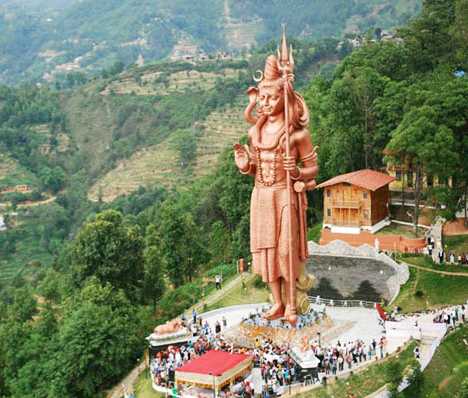
Kailashnath Mahadev (WORLD'S TALLEST LORD SHIVA STATUE)

WORLD'S TALLEST LORD SHIVA STATUE IS LOCATED IN NEPAL (KAILASHNATH MAHADEV. 143 FEET HIGH THIS STATUE IS ONE OF ITS KIND.

Kailashnath Mahadev Night Scene (WORLD'S TALLEST LORD SHIVA STATUE)

143 FEET HIGH STATUE WAS Inaugurated ON 21st June'2010

KAILASHNATH MAHADEV

This statue was inaugurated by one of the only four shankracharya from badri and the tourist minister on the 21st June 2010.

KAILASHNATH MAHADEV

This Statue is Made By Mr.Kamal Jain and It took him almost 5 years just to find this perfect location where he wanted his dream to come true.The construction started in 2004 and was completed in 2010.

KAILASHNATH MAHADEV

The Tallest lord shiva statue in the world (143 feet high) Situated in Nepal.

Showing posts with label Mantra for success. Show all posts

Saturday, December 10, 2011

SLOKAS ON LORD SHIVA

Kailaasarana Shiva Chandramouli
Phaneendra Maathaa Mukutee Zalaalee
Kaarunya Sindhu Bhava Dukha Haaree
Thujaveena Shambho Maja Kona Taaree

Meaning: Oh, Lord Shiva, who is seated on Mount Kailas, whose forhead is decorated with the moon and the king of serpents as a crown, who is the Ocean of Mercy and the remover of delusion, You alone can protect me. I surrender to thee.

MRITYUNJAYA MANTRA

Aum Trayambakam Yajaamahey
Sugandhim Pusti Vardhanam
Urvaarukamiva Bandhanaath
Mrutyor Muksheeya Maamritaat

Meaning: We worship the three eyed One (Lord Shiva) who is fragrant and who nourishes all beings; may He liberate me from death, for the sake of immortality, even as cucumber is severed from its bondage of the vine.
-------------------------------------------------------------------------------------
Mrutyunjayaaya Rudraaya
Neelakantaaya Shambhave
Amriteshaaya Sarvaaya
Mahadevaaya Te Namaha

Meaning: I pray to Lord Mahadeva who has conquered death, who is the destroyer of the universe, who has a blue neck and who gives happiness to all.

-------------------------------------------------------------------------------------
Vande Deva Umaa Pathim Suragurum
Vande Jagat Kaaranam
Vande Pannaga Bhooshanam Mruga Dharam
Vande Pashoonam Pathim
Vande Soorya Shashanka Vahni Nayanam
Vande Mukunda Priyam
Vande Bhakta Jana Ashrayam Cha Varadam
Vande Shiva Shankaram

Meaning:I bow down to the Lord of Uma (Parvathi), the divine Guru, the cause of the universe. I bow down to the Lord who is adorned with snake and wears tiger skin, the Lord of all creatures. I bow down to the Lord whose three eyes are the sun, moon and fire and to whom Lord Vishu is near. I bow down to the Lord who is the refuge of all devotees and the giver of boons, Shiva Shanakara.
-------------------------------------------------------------------------------------

Gauri Vallabha Kaamaarey
Kaala Koota Vishaasana
Maam Uddhhare Padambhoje
Tripura Agnyata Kaantaka

Meaning: Please save me, oh Lord Kaamaarey (another name for Lord Shiva). You are mother Gauri's consort; You are the One who drank the kaala koota poison (which resulted from the churning of the ocean); You are the destroyer of the three cities. Oh Lord I have taken refuge at Your Feet.

Thursday, October 13, 2011


The five mantras

Five is a sacred number for Shiva. One of his most important mantras has five syllables (namaḥ śivāya).Shiva's body is said to consist of five mantras, called the pañcabrahmans. As forms of God, each of these have their own names and distinct iconography:
These are represented as the five faces of Shiva and are associated in various texts with the five elements, the five senses, the five organs of perception, and the five organs of action. Doctrinal differences and, possibly, errors in transmission, have resulted in some differences between texts in details of how these five forms are linked with various attributes.The overall meaning of these associations is summarized by Stella Kramrisch:
Through these transcendent categories, Śiva, the ultimate reality, becomes the efficient and material cause of all that exists.
According to the Pañcabrahma Upanishad:
One should know all things of the phenomenal world as of a fivefold character, for the reason that the eternal verity of Śiva is of the character of the fivefold Brahman. (Pañcabrahma Upanishad31)

[edit]

Sunday, June 05, 2011

OM MANI PADME HUM

 "The jewel is in the lotus or praise to the jewel in the lotus"
         (by His Holiness Tenzin Gyatso The Fourteenth Dalai Lama of Tibet )


It is very good to recite the mantra
, but while
you are doing it, you should be thinking on its meaning, for the
meaning of the six syllables is great and vast. The first, OM, is
composed of three pure letters, A, U, and M. These symbolize the
practitioner's impure body, speech, and mind; they also symbolize the
pure exalted body, speech and mind of a Buddha.

Can impure body, speech and mind be transformed into pure body,
speech and mind, or are they entirely separate? All Buddhas are cases
of being who were like ourselves and then in dependence on the path
became enlightened; Buddhism does not assert that there is anyone who
from the beginning is free from faults and possesses all good
qualities. The development of pure body, speech, and mind comes from
gradually leaving the impure states and their being transformed into
the pure.
How is this done? 

The path is indicated by the next four syllables.MANI, meaning jewel, symbolizes the factor of method- the altruistic
intention to become enlightened, compassion, and love. Just as a
jewel is capable of removing poverty, so the altruistic mind of
enlightenment is capable of removing the poverty, or difficulties, of
cyclic existence and of solitary peace. Similarly, just as a jewel
fulfills the wishes of sentient beings, so the altruistic intention to
become enlightened fulfills the wishes of sentient beings.

The two syllables,
PADME
, meaning lotus, symbolize wisdom. Just as
a lotus grows forth from mud but is not sullied by the faults of mud,
so wisdom is capable of putting you in a situation of non-
contradiction where as there would be contradiction if you did not
have wisdom. There is wisdom realizing impermanence, wisdom realizing
that persons are empty of self-sufficient or substantial existence,
wisdom that realizes the emptiness of duality (that is to say, of
difference of entity between subject and object), and wisdom that
realizes the emptiness of inherent existence. Though there are may
different types of wisdom, the main of all these is the wisdom
realizing emptiness.

Purity must be achieved by an indivisible unity of method and
wisdom, symbolized by the final syllable,
HUM
, which indicates
indivisibility. According to the sutra system, this indivisibility of
method and wisdom refers to one consciousness in which there is a full
form of both wisdom affected by method and method affected by wisdom.
In the mantra, or tantra vehicle, it refers to one conciousness in
which there is the full form of both wisdom and method as one
undifferentiable entity. In terms of the seed syllables of the five
conqueror Buddhas, HUM is the is the seed syllable of Akshobhya- the
immovable, the unfluctuating, that which cannot be disturbed by
anything.

The natural mantra - Soham

The natural mantra - Soham  (Pronounced as So' Hum')

  Now let us learn about a mantra which repeats itself in all of us ! This the the natural mantra - Soham . 
 

  Till now I have told you about those mantra which  are required to repeated by the meditator. Now, I'll tell you about a mantra which is not needed to be repeated - because it is continuously repeating itself on its own - in all of us. This mantra is  So'ham - the natural mantra, the mantra of your true self. It does not belong to the East or the West or to any religion. So'ham  is the inherent in everybody, in all of us; it repeats itself continually, along with our breathing. It is said that as long as this mantra keeps going on inside us, there is life in the body. As soon as it stops, we are no more.
The meaning of So'ham is "I am That". Through these two syllables, we contemplate our oneness with the supreme consciousness. Through the ever going process of breathing, our 'self' keeps repeating this mantra -  I am that.


  The heart is considered as the source of So'ham. It is from the heart that the syllables of 'So' and 'Ham' arise, and again in the heart that they subside. If you observe your breath, you will notice that it arises from within with the sound So', goes out of the body to a distance of about twelve fingers, and dissolves there. A fraction of a second later, the inhalation arises with the sound ham and goes back into the body. It merges in the heart for a split second and then arise again in the form of 'So. Between the inhalation and the exhalation, and between the exhalation and inhalation, there is a fraction of second which is absolutely still and free of thoughts.( It is the same moment of pause that I explained in Pause breath method of Deep Breathing)  . That space is the space of the truth. When you breath in and out, listening the ham  and so, you should focus on that space for as long as it lasts. As you practise the technique, the space will gradually expand.

Observing the So'ham is a natural Sadhana, a natural yoga. It is known as ajapa-japa, the unrepeated mantra repetition. Since So'ham goes on within you all the time, you do not have to make an effort to repeat it. All you have to do is become aware of it. You do not need any faith. You just have to watch the space of truth.

Since this technique is very subtle, you have to practise it for a while in order to understand it. Whenever you sit quietly, follow your breath and listen to the mantra. If you do not immediately become aware that the mantra (So'ham) is repeating itself, you can repeat the syllables along with your breathing. (So' during exhalation and ham' during inhalation In a few days you will be able to synchronize the mantra with your breath. Soon you will begin to hear the mantra naturally. If you practice it for a while, you will experience the self.

The practice of So'ham is recommended in the Upanishads and the Vedas. It has been said about So'ham that :
Watch the So'ham. Those who contemplate So' ham ceaselessly, discarding worldly entanglements, they attain the supreme state and their worldly bondage is destroyed.                     
           While repeating So'ham, keep in mind that the goal and practice of So' ham are the same. So' ham means "I am that," and if you practise it with complete concentration, being aware of the breath coming in and going out, you will experience That (which is nothing but your true self). The truth is that you do not really have to practise it, because you are already That. The practise of So' ham is a matter of understanding. You are not required to repeat it . It is already going on in you. You have to just watch and listen it. Just watch the breathing process, listen the So'ham and realize the true self present in you which always says 'I am that'

OM Shanti OM

OM Shanti OM

 (New : You can now listen to Om. See download details below ) 
OM or AUM is the most important and significant word of Mantra tradition. It is considered as the root mantra of all mantra. In a majority of Mantra, you will find OM. 
   OM is the most often chanted sound among all the sacred sounds on earth. This sound is considered as the sound of the existence. 
 it is believed that the whole universe, in its fundamental form,  is made up of vibrating, pulsating energy. Om is considered as the humming sound of this cosmic energy. 
OM is said to be the original primordial creative sound from which the entire universe have  manifested. It is also known as the 'Anahat Nada', the "Unstruck Sound". This means the sound that is not made by two things striking together. 
If you observe the nature of sound you'll find that all ordinary audible sound are produced by the striking of two objects : bow and strings, drum and stick, two vocal cords, waves against the shore, winds against the leaves, bat against the ball, tyers against the road etc. In short all sounds within our range of listening are produces by things visible or invisible, striking each other or vibrating together, resulting in pulsating waves of air molecules which  we interprets as sound. 
In contrast to the above, OM is the sound which is not the result of the striking of two objects. It, rather emanates on its own. It is the primal sound of the universe that contains all sounds in itself.  
The meaning of OM 
 Well unlike all other mantra, there is no meaning of OM. It is actually not a word, it is a sound. As per Hindu tradition, OM is the purest name of God. It is the sound of the supreme consciousness. So when you reapeat OM, you actualy take the name of God. 
Now without going into the further philosophical explanation of OM, let us learn how to meditate using OM. Repetition of OM or AUM dissolves the mind it its divine source. The chanting of OM several time loud, purifies the atmosphere. 
Sit in a comfortable undisturbed place. Take some deep breath. Now chant at least 7 times OM in succession. Make each breath last as long as possible. Teak deep breath and chant Oooooooo~~~~~hhhhhhhhhh~~~~~ Mmmmmmm~~~~~. Then again repeat this chanting of OM. Do this for 7 times. After this, stop chanting and sit for a moment of silence. You will be amazed by the inner peace you'll get in such a small chanting of OM. 
Listen the sound of Universe :  Let us listen the sound of OM. You are requested to   listen carefully. This sound of OM produces instant positive vibrations and takes the listener to a state of mental stillness. 
Chanting the OM mantra for 15 minutes daily can produce remarkable effect in you. This mantra will help you to calm the mind, settled the thought process and realize the self.

.
Listen to OM now !!
Download this small (just 164 KB) mp3 file of OM. Listen to this powerful vibrating sound of Universe now. 
It's a very small file and you can listen to it within seconds. 
Click here The sound of Om  
(if you click with your left mouse button, it will directly play the file)
(if you click with Right mouse button you'll be prompted to save the file. Save it in your hard disk)
After downloading it, play it on your favorite media player and switch on the repeat button. It'll keep repeating itself. Enjoy !. 
(Please note: Very important !  Don't listen to Om while you are busy (for example while driving or doing important tasks requiring mental effort). Stop listening it if you feel uneasy. Not recommended for heavy meat eaters)

What is Om Namah Shivaya

Om Namah Shivaya is known as the great redeeming mantra also known as five-syllable mantra

The meaning :  
It means  "I bow to Shiva." Shiva is the supreme reality, the inner Self. It  is the name given to consciousness that dwells in all. Shiva is the name of your true identity- your self. 
According to Hindu mythology there are three Gods who run this creation. The Brahma - who creates the universe, the Vishnu - who preserves the Universe and the Shiva- who in the end destroys the universe. Among the three deities, Shiva, though considered as destroyer, also symbolize the  - the inner self which remains intact even after everything ends. 
In this mantra the chanter (one who repeats the mantra) bow to Shiva- his true self.
              Om Namah Shivay is a very powerful mantra. It has been said about this mantra that if this mantra vibrates continually in your heart, then you have no need to perform austerities, to meditate, or to practise yoga. To repeat this mantra you need no rituals or ceremonies, nor must you repeat it at an auspicious time or in a particular place." This mantra is free of all restrictions. It can be repeated by anyone, young or old, rich or poor and no matter what state a person is in, it will purify him.
How to repeat 'Om Namah Shivay' 
            Sit in a comfortable and peaceful  place and position. Start repeating the mantra in your mind or loudly with the same speed as you talk: 
 Om Namah Shivay (Aum Num-ha Shi-why)
( To repeat any mantra as already mentioned in General Rules : one should repeat it with full awareness of its meaning. )
 Repeat 'Om Namah Shivay', with the feeling that you are bowing to Shiva - your true inner self. Repeat this mantra with respect. The inner self is the form of God in you. So as you say ' Om Namah Shivay' i.e. "I bow to Shiva'; you are actually bowing to God - The great almighty. The repetition of the name of God is equivalent to be merged in his very being.  When you repeat God's name in your mouth, in one way, you experience the God itself. Just repeat this mantra with faith and it's powerful phonetic vibrations will start doing miracle for you.

Monday, May 09, 2011

The Worship of Sivalinga

According to the Sivapurana, in the age of Kali (kaliyuga) ,worship of Siva in the form of Sivalinga is the best means of liberation. Woship of Sivalinga can be done either at home or in a Siva temple or a sacred place such as the banks of a sacred river. The linga has to be worshipped by the traditional means (sadupachara) of  :
  1. dhyana,
  2. avahana,
  3. asana,
  4. padya,
  5. arghya,
  6. achamaniya,
  7. abhisheka,
  8. vastra,
  9. bhasma,
  10. gandha,
  11. akshata,
  12. pushpa,
  13. bilva,
  14. dhupa,
  15. dipa,
  16. naivedya,
  17. tambula,
  18. mahanirajana,
  19. mantrapushpa,
  20. namaskara and
  21. prardhana.

Saturday, May 07, 2011

What is Rudraksha: Rudraksha word is related to Hindu Religion. Rudraksha tree and seed both are called Rudraksha. In Sanskrit Rudraksham means Rudraksha fruit as well as Rudraksha tree.
Rudraksha tree grows on mountains and hilly region of Nepal, Indonesia, Java, Sumatra and Burma. Its leaves are green in colour and the fruits are brown in color and sour in taste. The Rudraksha fruits also adorn the human beings because of spiritual values.


Found in Ancient Indian Scriptures and texts: From ancient times, the power of Holy Rudraksha beads have been scripted in various religious texts like ShivmahaPurana, Shreemaddevibhagwat, Padma Purana, ling Purana, Ashtamalikopnishad, Nirnayasindhoo, Mantramaharnava, Mahakaal Sanmhita, Rudrakshajabalopnishad, Vrihajjabalopnishad, Shivaswarodaya and Sarvollastantra.
As per ancient Indian scriptures mentioned above Rudraksha is evolved from the eyes of Lord Shiva hence, it’s called Rudraksha. Rudra means Shiva and Aksha means eyes. Aksha also means a group of alphabets in Sanskrit called (Varna). As per details found in Halayudh Kosha(Ancient Scripture) letters from A to ksha that is 51 letters are called Aksha . Therefore, Rudraksha can be called as a seed in which a group of Sanskrit letters called Varna reside.

Perfect for Body, Mind & spiritual gains: Rudraksha evokes power in the body, which fights against diseases hence improving overall health. As per Ayurveda, Rudraksha strengthens the body constitutions. It removes the blood impurities and strengthens the body substance. It removes the bacteria inside as well as outside the Human Body. Rudraksha removes the headache, cough, paralysis, and blood pressure, heart disease and maternity problems. Wearing of Rudraksha brings glow on the face, which results in calm and charming personality. Rudraksha rosary is used for Japa. The process of Japa increases spiritual power and self-confidence to move in multi direction of life. Therefore, Rudraksha seeds are found be useful for providing health benefits as well as helps in gaining spiritual success. Wearing Rudraksha results in the destruction of sins from previous birth that cause difficulties in the present life. The men who are Mlechchha, chandaal (impious and inhumane) or full of all kinds of vices can get the form of Lord Rudra by wearing Rudraksha. This helps in getting rid of all the sins and gets him to attain the supreme goal of his life.

Tuesday, April 19, 2011

Ganesh Mantra

Ganesha Mantra

Mantra for Success


Vakrtund Mahakaya Surya Koti Samaprabha
Nirbhignam Kurumedaya Sarva Karyashu Sarvada

Legend has it that Lord Ganesha received this distinction as a blessing from his parents, Lord Shiva and Goddess Parvati. Lord Shree Ganesh is god of knowledge and the remover of obstacles. Lord Ganesha is worshipped, or at least remembered, in the beginning of any auspicious performance for blessings and auspiciousness.

The Lord of Success
The son of Shiva and Parvati, Ganesha has an elephantine countenance with a curved trunk and big ears, and a huge pot-bellied body of a human being. He is the Lord of success and destroyer of evils and obstacles. He is also worshipped as the god of education, knowledge, wisdom and wealth. In fact, Ganesha is one of the five prime Hindu deities (Brahma, Vishnu, Shiva and Durga being the other four) whose idolatry is glorified as the panchayatana puja.